




Xiu Yuan

Xiu Yuan

Embodied intelligence with foundation models

I'm a first-year Computer Science PhD student at Washington University in St. Louis, advised by Prof. Chongjie Zhang. I received my B.S. in Computer Science from UC San Diego, where I was advised by Prof. Hao Su, and my high school study at Nanjing Foreign Language School.

In Summer 2026 I interned at Waymo as a Research Intern on the Pre-training team within AI Foundations, mentored by Kratarth Goel (Senior Staff Research Scientist, Tech Lead), Jonah Philion (Senior Research Scientist), and Qi Zhao (Staff Software Engineer). My work focused on improving the reasoning capabilities of driving foundation models.

Portrait of Xiu Yuan

Research

My research focuses on advancing embodied intelligence with foundation models. I organize my work around three core pillars:

  1. Efficient online adaptation and continual improvement of low-level embodied control models, including vision-language-action models (VLAs) and world-action models (WAMs).
  2. Stronger reasoning capabilities for high-level embodied models, particularly vision-language models (VLMs).
  3. Agentic robotic systems that can autonomously plan, adapt, coordinate, and interact with the physical world.

I'm always happy to collaborate on interesting projects. If you'd like to chat, feel free to shoot me an email.

Industry Experience

Education

Publications & Preprints

Sorted by recency. Highlighted entries are representative papers.

MATCHA: Bridging the Gap between Sample and Wall-Clock Efficiency in Model-Based Multi-Agent Reinforcement Learning

Jianing Ye, Yang Zhang, Xiu Yuan, David Park, Qihan Liu, Chongjie Zhang

  • Submitted to NeurIPS 2026
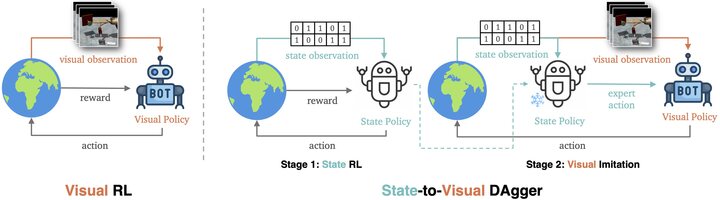
State-to-Visual DAgger method diagram
When Should We Prefer State-to-Visual DAgger Over Visual Reinforcement Learning?

Tongzhou Mu*, Zhaoyang Li*, Stanislaw Strzelecki*, Xiu Yuan, Yunchao Yao, Litian Liang, Hao Su (* equal contribution)

  • AAAI 2025

arXiv Code

Visual reinforcement learning trains policies directly from visual observations, but faces challenges in sample efficiency and compute cost. This study empirically compares State-to-Visual DAgger — a two-stage framework that first trains a state policy, then uses online imitation to learn a visual policy — against Visual RL across a diverse set of tasks.

Enhanced Contactless Salt-Collecting Solar Desalination

Yue Bian, Zhihao Ye, Gengyou Zhao, Kun Tang, Yan Tang, Si Chen, Lijuan Zhao, Xiu Yuan, Shunming Zhu, Jiandong Ye, Hai Lu, Yi Yang, Lan Fu, Shulin Gu

  • ACS Applied Materials & Interfaces 2022

Paper

A paper-based thermal radiation-enabled evaporation system (TREES) achieves sustainable, highly efficient salt-collecting desalination, featuring a dynamic evaporation front based on the accumulated salt layer where water serves as its own absorber via energy down-conversion. On 7 wt % brine it continuously evaporates water at 2.25 L m−2 h−1 under 1 sun illumination — well beyond the input solar energy limit — for over 366 hours.

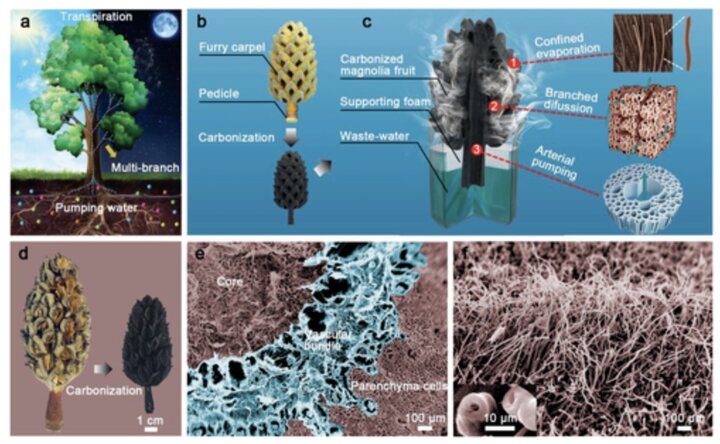
Carbonized magnolia fruit evaporator
Carbonized Tree-Like Furry Magnolia Fruit-Based Evaporator Replicating the Feat of Plant Transpiration

Yue Bian, Yang Shen, Kun Tang, Qianqian Du, Licai Hao, Dongyang Liu, Jinggang Hao, Dong Zhou, Xiaokun Wang, Huiling Zhang, Peiye Li, Yimeng Sang, Xiu Yuan, Lijuan Zhao, Jiandong Ye, Bin Liu, Hai Lu, Yi Yang, Rong Zhang, Youdou Zheng, Xiang Xiong, Shulin Gu

  • Global Challenges 2019

Paper

Magnolia fruits, as tree-like living organisms, can become outstanding 3D evaporators through a simple carbonization process. The mini tree possesses omnidirectional high light absorptance with minimized heat loss and gains energy from the environment. Water confined in the fruit has reduced vaporization enthalpy and transports quickly following Murray's law, achieving a record-high vapor generation rate of 1.22 kg m−2 h−1 in the dark and 3.15 kg m−2 h−1 under 1 sun illumination.